Nathdwara Shrinathji Temple Timings 2026: All 8 Darshans, Rules and How to Plan Your Visit
Last verified: September 2026. Nathdwara’s darshan times change every day with the season and festival calendar — the temple publishes the day’s schedule on nathdwaratemple.org each morning. Treat the times below as typical, not fixed.
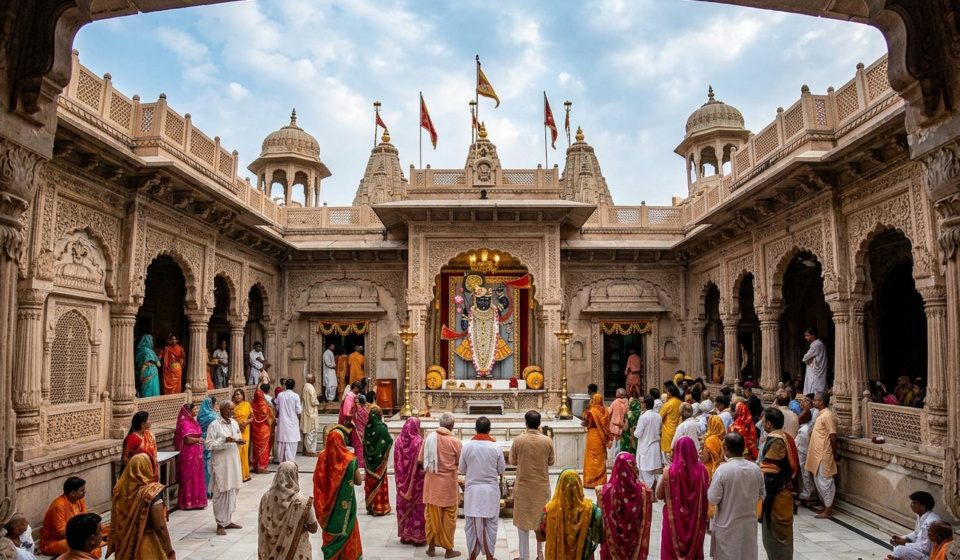
Nathdwara is not a temple in the usual sense; the town calls it Thakurji ki Haveli — Shrinathji’s house. The deity is treated as a seven-year-old Krishna, and the whole day is built around his routine: waking, dressing, taking the cows out, lunch, an afternoon nap, dinner, bed. Devotees see him eight times a day, for 30–45 minutes each, and in between the doors are shut. Get the timing wrong and you’ll wait an hour outside a closed haveli. This guide explains the rhythm.
The Eight Darshans (Jhankis)
| Darshan | What’s happening | Typical time (varies daily) |
|---|---|---|
| Mangla | Shrinathji is woken; doors open after initial rituals | 5:30 – 6:00 AM (earlier in winter) |
| Shringar | He is dressed and adorned; flute placed in his hand | 7:15 – 7:45 AM |
| Gwal | He takes the cows to pasture; sometimes not opened to public | 9:15 – 9:30 AM |
| Rajbhog | The main meal — the most elaborate darshan of the day | 11:15 AM – 12:00 PM |
| Uthapan | He wakes from the afternoon nap | 3:30 – 3:45 PM |
| Bhog | A light evening meal | 4:45 – 5:00 PM |
| Sandhya Aarti | Evening aarti as the cows come home | 5:15 – 5:45 PM |
| Shayan | He retires for the night | 6:45 – 7:15 PM (not held for six months, Chaitra to Ashwin) |
Each jhanki opens for roughly 30–45 minutes. Mangla and Rajbhog are the two everyone tries for — Mangla for the intimacy (doors opened gently so the child isn’t startled), Rajbhog for the spectacle: a priest on the terrace calls “Mala begi laiyo!” (bring the garland quickly), drums roll, and the doors are flung open.
Because the times shift, the working rule is: reach the gate at the published start time or five minutes after, not before — the rush is in the first five minutes.
Rules Inside
- Darshan is free. There are no paid or VIP tickets.
- No mobile phones or shoes. Free lockers at the gate; the queue for them takes 10 minutes, so leave your phone in the hotel if you can.
- Small bags and purses are allowed.
- Dress modestly. Traditional wear is the norm here, not enforced.
- Wheelchairs are available for senior citizens, with a separate gate; the attendant will expect a tip.
- The Pritam Poli side entrance is usually quieter than the main one.
- If you buy milk or flowers as an offering, you can go upstairs to the specific rooms (Doodh Ghar, Phool Ghar) and see the haveli’s inner quarters.
Prasad
Nathdwara’s prasad is a thing in itself: mathri, thor, magas, and the seasonal sweets, all cooked in the haveli’s own kitchens. Buy from the temple counters. The town’s shops sell versions of the same but the haveli’s is what people carry home.
Around the Haveli
- Shri Navneetpriyaji Mandir and Vitthalnathji — smaller Pushtimarg shrines a few minutes’ walk.
- Pichwai painting workshops — the cloth paintings of Shrinathji originated here; Chitron ki Gali has artists at work.
- Statue of Belief (Vishwas Swaroopam) — the 369-ft Shiva statue on the edge of town, opened 2022; light show in the evening, ticketed.
- Eklingji and Nagda (about 25 km towards Udaipur) — easy to combine on the drive.
How to Reach
- Air: Udaipur (Maharana Pratap) Airport, about 60 km, 1.5 hours.
- Rail: Mavli Junction 30 km; Udaipur City 48 km, better connected.
- Road: Udaipur 48 km (1 hour), Ahmedabad 300 km (5–6 hours), Jaipur 340 km. Regular Rajasthan Roadways buses from Udaipur; taxis about ₹1,500 one way.
Where to Stay
The town has dozens of dharamshalas and havelis-turned-guesthouses within walking distance; Nathdwara’s own trusts run several. For hotels with more comfort, Udaipur is close enough to day-trip, but staying in town is the only way to catch Mangla.
Best Time to Visit
October to March. Big festival days: Janmashtami (August), Annakut the day after Diwali (October/November) when a mountain of food is offered, Holi (March) with a week of colour, and Nand Mahotsav. All draw enormous crowds; darshan times are extended and published specially.
Frequently Asked Questions
Eight darshans from around 5:30 AM to 7:15 PM, each open 30–45 minutes. Exact times change daily and are published on the temple’s website.
No. All darshan is free; there is no ticketed queue.
No. Free lockers at the entrance.
Mangla for calm, Rajbhog for the full spectacle. If you can only do one, Rajbhog.
About 48 km, an hour by road.
No — it is skipped for about six months of the year (Chaitra to Ashwin), when Shrinathji is believed to visit Vraj at night. Times cross-checked against the Nathdwara temple’s published schedule and recent devotee reports, September 2026. Spotted a change? Email info@themandiryatra.com.
Times cross-checked against the Nathdwara temple’s published schedule and recent devotee reports, September 2026. Spotted a change? Email info@themandiryatra.com.
Editor at The Mandir Yatra. Covers the Himalayan and northern yatras (Kedarnath, Vaishno Devi, Govardhan, Narmada Parikrama) and the southern and eastern temples (Tirupati, Kanyakumari, Srikalahasti, Draksharamam, Jagannath Puri, Kamakhya). Every guide is checked against the temple trust’s official schedule before publishing and carries a last-verified date.