Last verified: September 2026. Narmada Parikrama routes, ashram stays and river crossings change with the season and monsoon — confirm locally before each stage.
What is Narmada Parikrama? What Does This Pilgrimage Entail?
Narmada Parikrama is the spiritual journey of walking around the Narmada River, which is considered to be one of the most sacred rivers in India, worshiped not only for being a river but also as a Goddess in Hindu traditions. Parikrama is a term used to describe circling the holy thing, whether it is a sacred place or temple, in a manner similar to those who make a pilgrimage to Vrindavan for visiting Govardhan Hill. In this case, the object of devotion would be the whole river, starting from her source point in Amarkantak in Madhya Pradesh all the way to the meeting point with the Arabian Sea at Bharuch, Gujarat, and back on the other bank. One thing that sets this pilgrimage apart from others in India is the scale of this spiritual experience, since it cannot be done for any other river, because there isn’t even a name for such a concept. There isn’t such thing as Ganga or Yamuna Parikramas. However, Narmada is the only Indian sacred river that has this type of parikrama described in scriptures like Skanda Purana Reva Khand and Vayu Purana. Unique about this pilgrimage among all of the Indian pilgrimages is its massive scale along with the fact that it involves the only river in India which has this practice. You can neither perform a Ganga parikrama nor Yamuna parikrama for that matter. The Narmada is the only holy river in India around which this parikrama pilgrimage has to be done as instructed in scriptures like the Skanda Purana’s Reva khand and Vayu Purana. It covers a distance varying from 2,600 to 3,800 kilometres depending on the actual path followed because of modifications in river routes due to dams and reservoirs which cover up the older paths taken during the circuit. Usually done by walking, it takes about 3-6 months to cover this distance although some enthusiasts take even longer than a year to accomplish their goal. According to ancient religious scriptures, it used to take 3 years, 3 months, and 13 days.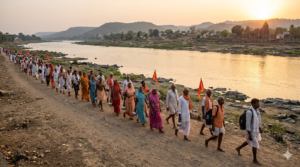
Why Is Narmada Different From Other Sacred Rivers?
To understand how it happened, one needs to start from understanding why Narmada is special among all other sacred rivers in Hinduism. The following Sanskrit proverb should be cited here: “Ganga Snan, Narmada Darshan”. This means that bathing in the Ganga River provides no greater merit than the mere viewing of the Narmada River. The sanctity attached to Narmada River is that deep. According to Hindu myths, the Narmada is Shiva’s daughter who sprang out of his penances. The River is worshipped under her second name, Shankari, which means “the powerful goddess who is both fearful and gracious.” On coming down from Heaven, she made three demands to her father: she must not come to an end even in a Pralaya (i.e., in a great cosmic catastrophe), every stone shaped like Shivalinga found in the River must be worshiped without any need for a special ceremony of its consecration, and finally, all the gods should live on its banks. It is for this reason that one finds the Narmadeshwar Shivalingas, which are smooth black stones collected from the bed of the river Narmada, venerated in houses throughout India without any need for a prana pratishtha ceremony. They have already been sanctified by the river. As per the Skanda Purana, the act of performing parikrama is regarded as being as meritorious as performing both Kashi Yatra and the circumambulation of Mount Meru. It is believed that saints such as Adi Shankaracharya and Markandeya Rishi performed the parikrama of the banks of the Narmada.Full Course of Narmada Parikrama: Journey Route, Length, and What It Includes
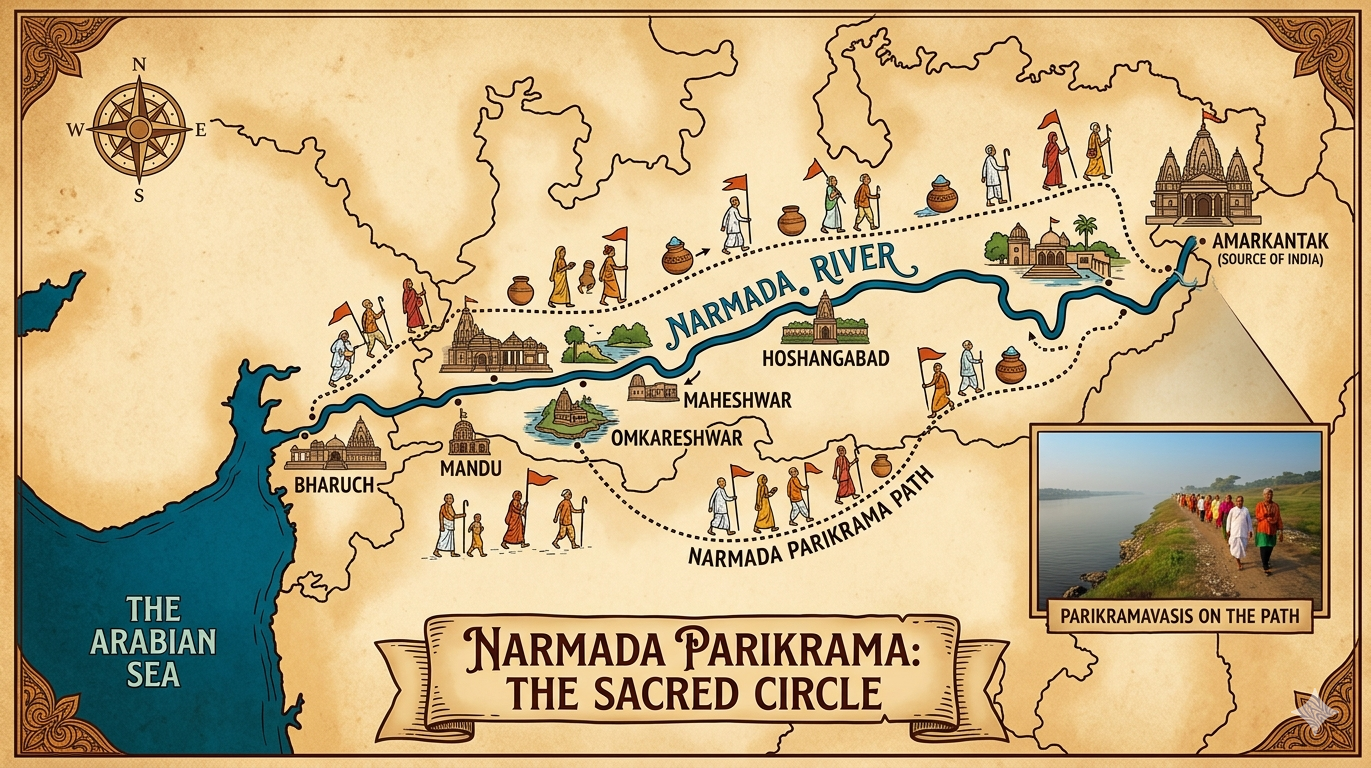
The full parikrama commences from the tiny hilly town of Amarkantak in eastern Madhya Pradesh, from where the Narmada emerges from a kund of the Narmada Udgam temple with utmost shyness, in the manner of a bashful girl. The journey proceeds further downstream from Amarkantak on the south bank (Dakshin Tat) of Narmada, passing through:-
South Bank:
- Amarkantak – Bharuch Amarkantak → Dindori → Mandla → Jabalpur → Bhedaghat → Narmadapuram (Hoshangabad) → Omkareshwar → Maheshwar → Mandleshwar → Badwani → Sardar Sarovar Dam → Bharuch
-
North Bank:
- Bharuch – Amarkantak Bharuch → Garudeshwar → Tilakwada → Kevadia (Statue of Unity) → Kukshi → Dhar → Indore → Nemawar → Khandwa → Barman Ghat → Mandla → Dindori → Amarkantak
Temples and Important Religious Sites on the Journey
- Narmada Udgam Temple, Amarkantak – The origin point. This site provides the perfect starting and ending point for the parikrama. Unlike the power that emanates from Jyotirlingas, this place is serene.
- Bhedaghat, Jabalpur – A spectacular place that will take your breath away. In Bhedaghat, Narmada flows between two magnificent limestone cliffs. In addition, the Chausath Yogini Temple at this location is situated on a hill and boasts spectacular panoramic views.
- Omkareshwar – The most important stop of the entire parikrama route. This is one of the twelve Jyotirlingas, situated in the middle of an island that naturally resembles the Om symbol in the Narmada river. There’s a parikrama within a parikrama here. This pilgrimage is literally a pilgrimage inside a pilgrimage as the temple itself boasts its own parikrama route. Initiated into monastic life, Adi Shankaracharya was initiated by his guru, Govindapada, here, in a cave. Staying at the ghats of Omkareshwar and watching the reflection of aarti flames from the Narmada river is one of those moments when words seem too limited.
- Maheshwar – Another temple town founded by Queen Ahilyabai Holkar during the 18th century. The ghats are always spotless, the river wide and calm. There’s another special feeling about Maheshwar, compared to other stops – it’s somehow regal and femininely beautiful.
- Shulpaneshwar/Vyara, Gujarat – An ancient Shaivite shrine in Gujarat, just close to the border of Maharashtra and highly important to Gujarati pilgrims. The atmosphere changes once you’ve entered Gujarat – the terrain becomes flatter and the river wider.

The Uttarvahini Narmada Parikrama: The One Day Parikrama with the Same Impact
It isn’t possible for everybody to have such long breaks in their lives and undertake the complete parikrama of the river. But that’s not a problem as far as the Uttarvahini Narmada Parikrama is concerned. There are sections of the Narmada River which display an unusual geographical characteristic of flowing northwards. It may be recalled that most of the Indian rivers flow towards the south and the west because of the natural slope of the sub-continent. The Narmada River normally flows to the west but near the areas of Rajpipla and Tilakwada in the Narmada district of Gujarat, she turns northwards near Rampura Ghat. Uttarvahini in Sanskrit means “flowing north,” and this northwards flow is considered to be very auspicious according to Hindu mythology. The parikrama of this part of the river is regarded as spiritually equal to a long-distance pilgrimage. The Uttarvahini Panchkoshi Narmada Parikrama involves a distance of about 15 to 21 kilometres which can be covered within one day, starting from around 3 or 4 AM. This particular parikrama is conducted every year in the Hindu month of Chaitra (March-April). For the year 2026, it was held between March 19 and April 17. Thousands of pilgrims from the states of Gujarat, Maharashtra, and Madhya Pradesh gather at Rampura Ghat. The route starts from Rampura Ghat through Mangrol, Tapovan Ashram, Gopaleshwar Mahadev Temple, Sitaram Temple, along the riverbed, crosses to the north side by boat, reaches the village of Tilakwada, performs darshan at Maninageshwar temple and returns to Rampura Ghat via boat.I undertook this particular parikrama last month and am still digesting it.
The journey started at 3:30 AM with absolute darkness, a torch in hand, the river barely perceptible as moving darkness to the right, and the sound of footsteps of thousands of others in the quiet surroundings – it was walking within a prayer itself. It is easy to follow the trail. It does not have any difficult stretches; the path is usually flat and sandy and sometimes leads across banana fields or over footbridges over streams. The challenge lies elsewhere. Small stations were set up by villagers along the way to offer chai, jaggery, poha, and bananas all through the night. No monetary transactions occurred here. No one even suggested anything like that. In a small village, there was an old lady who handed me some chikki when it was just five in the morning, and when I tried to take out money from my pocket, she would not even make eye contact with me. She simply told me, “Ma ne bheja hai.” The mother sent it. This simple act of generosity destroyed something inside me which had been tightly held for many years. The boat journey in the vicinity of Tilakwada starts in the morning, and experiencing sunrise from a tiny wooden boat in the presence of other pilgrims softly chanting “Narmade Har” creates an experience that prompts one to reflect on all notions of beauty that they have encountered before. Registration information for 2026: The Gujarat administration has made it mandatory for participants in the Uttarvahini route to register themselves online. Registrations can be done at the Gujarat yatra website. QR codes and RFID bands are distributed to all registered pilgrims. It is recommended that registrations should be done at least six months prior to the event, as many slots get booked by February in 2026.
Important Rules of Narmada Parikrama That Every Pilgrim Should Follow
The below rules need to be followed irrespective of whether one is doing a full Narmada parikrama or an Uttarvahini Narmada parikrama. The rules should be followed very strictly as per the traditions of Narmada parikrama: The river should always be on the pilgrim’s right hand. This is the important rule in Narmada parikrama. One is performing the parikrama of Narmada. Narmada should always be to one’s right hand during Narmada parikrama. No crossing of river during parikrama. If one wants to take the full Narmada parikrama, then he/she can cross the river only twice: once at Bharuch (sea confluence) and once at Amarkantak (source of Narmada river). A sankalp should be made before starting the parikrama. Most of the pilgrims take the sankalp at the beginning of Narmada parikrama. For the Uttarvahini Narmada parikrama, Sankalp puja is performed at Garudeshwar. Sattvic lifestyle throughout. Consumption of non-vegetarian food items, alcohol, and intoxicants is completely shunned. Full parikrama walkers generally rely solely on the food provided by local residents on the way — they usually have no money on them deliberately to make a statement of surrender. Offer worship to the river twice daily. Daily aarti is carried out at dawn and dusk on the riverbanks where diyas and flowers are offered to Narmada Maiya. Deepdan. The ritual of lighting and offering diya to the river takes place at every single ghat on the way. The most touching ritual in the entire Narmada river walk, carried out every evening.Best Time for Narmada Parikrama
For full parikrama: Ideal time is from October to February. Weather in Madhya Pradesh and Gujarat state is favorable during those months, water level is normal due to monsoon being over, and the trekking conditions are excellent. It is strongly recommended not to visit during monsoon season because of high water level and difficult trekking path.Regarding the Uttarvahini Parikrama:
It takes place only during Chaitra (March-April). This is the sole opportunity for the same. Walking in the morning until 9 AM is easy; the Gujarat climate gets harsh around noon, making it necessary to start early. Navratri days and Narmada Jayanti attract huge crowds at major ghats, especially Omkareshwar and Amarkantak. This makes for an awe-inspiring sight, although there will be large crowds.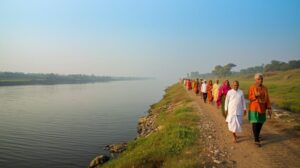
Practical Tips From Someone Who Has Done It
In case of full Narmada parikrama: You cannot afford to take physical preparations lightly. Walking daily for months before taking up the challenge is imperative. Most pilgrims gradually reach up to walking 25-30 km per day. This activity will test your feet to the fullest extent possible. In case of Uttarvahini short parikrama: You should have walking shoes. Some pilgrims undertake this journey barefooted as an exercise, but for new pilgrims, wearing comfortable sports shoes might serve the purpose better. Keep drinking water and some snack handy, plus a torch. Dress up in traditional clothing. Wherever: Always keep your identity proof along. Keeping some cash in a waterproof pouch might come handy on this occasion, particularly if you’re walking through the Gujarat circuit where registration is mandatory for all pilgrims. Language: Hindi is the language of communication all through the MP sections. In Gujarat, both Gujarati and Hindi serve the purpose equally well. The people living along the parikrama path are always very hospitable towards the devotees coming for the parikrama; it is the tradition of Narmada-belt people to welcome the parikramavasis with honour and hospitality. Where to stay for the complete parikrama journey: There are ashrams and dharamshalas available at all places along the route. Most of them provide free or nominal accommodation. The cities of Omkareshwar, Maheshwar, and Hoshangabad give better accommodation. For Uttarvahini, there are good choices available at Garudeshwar and Rajpipla.What Narmada Parikrama Really Does to You?
The question has bothered me since I myself experienced it and the answer I am finding every time is the same – it works its magic without making you aware of its effect. While you are walking, handling your body, observing the river and managing your way through the route, there is something else going around inside you. And one day, maybe when you are on the ferry ride early morning, everything just… loosens up! Those people who have gone through the entire parikrama journey say that the first week is the most difficult week because of pain, nostalgia, questions of doubt and the reason behind it all. Then comes the second week when the body adjusts itself to the process. Third week sees the calming down of the mind. And thereafter something else begins; a presence which becomes very difficult to maintain in normal urban life yet comes naturally to you when you walk along the Narmada River. A conversation with a retired engineer at the age of 65 years who did the entire journey on wheels revealed something which has made me ponder ever since: “It was not the temples alone that were charged with energy, but the stretches of distance between each temple – just the river and road and silence.” And that sums up the Narmada Parikrama.Conclusion: Narmade Har
There is a chant that all parikramavasis utter from the first step to the last: “Narmade Har.” This is an invocation—an acceptance of the river. “Har” means “take away,” and what you are requesting the Narmada to take away from you is anything that you no longer need. Ego, fear, and anything that has built up within your body because you have measured your life using a false standard. Whether it is 3,500 kilometers in six months or 21 kilometers in a day—the Narmada requires nothing different of you. You need only show up. Walk with her on your right side. Allow her to do what she has always done for her pilgrims. She will. Narmade Har.
Editor at The Mandir Yatra. Covers the Himalayan and northern yatras (Kedarnath, Vaishno Devi, Govardhan, Narmada Parikrama) and the southern and eastern temples (Tirupati, Kanyakumari, Srikalahasti, Draksharamam, Jagannath Puri, Kamakhya). Every guide is checked against the temple trust’s official schedule before publishing and carries a last-verified date.