Last verified: September 2026. Parikrama routes and temple timings along the way change; confirm locally, especially during Guru Purnima and Govardhan Puja when the route is managed by the administration.
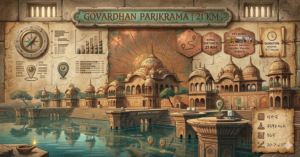
What Is Govardhan Parikrama?
It refers to the holy circumambulation of Govardhan Hill, which is the very hill lifted up by Lord Krishna on His little finger to save the inhabitants of Vrindavan from the fury of Indra. Parikrama just means ‘walking around’, walking in complete circles around the hill. It is not a mere journey, for every step one takes here is an offering. Devotees recite prayers, sing devotional songs called bhajans; while others take the full circuit on their knees by doing dandavat pranam, others walk on bare feet throughout the year irrespective of weather conditions.Govardhan Parikrama Distance — How Long Is the Route?
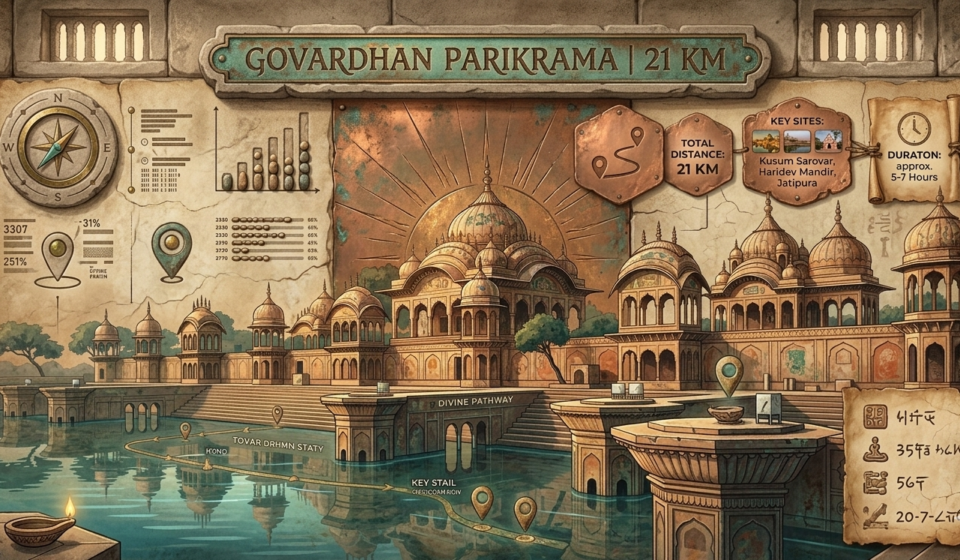
This is the question that most people have right away, and the answer is: The total distance for Govardhan Parikrama is roughly 21 kilometers. Yes, 21 km! Now, I realize that does sound like a considerable distance, but then again, it’s totally possible for an average healthy adult to complete in 6 to 8 hours if walking reasonably fast with brief pauses. For elderly devotees, the duration usually ranges from 10 to 12 hours, while for people who do dandavat parikrama, it may even take days to complete! For the purpose of our discussion, there are virtually no ups and downs, hills or anything else on the Govardhan Parikrama route. Even the Govardhan Hill is not really high; it rises up to around 25 meters above the rest of the landscape in the area. So the real challenge is about physical endurance and, of course, heat if you do parikrama during summer. The entire path is well marked and passes by several villages, ghats, temples, and kunds. Among others, you will visit Radhakund, Shyamkund, Mansi Ganga, Kusum Sarovar, Dan Ghati, and Punchari ka Lautha.Govardhan Parikrama Starting Point — Where Do You Begin?
Although there are no strict guidelines about the starting point of the parikrama, the popular one is starting Govardhan from Govardhan town, near the temple of Mukut Mukharvind or at Mansi Ganga Ghat. Those who are traveling by buses or vehicles will be dropped near the main Govardhan town, and so starting from Mansi Ganga is easier for them. The parikrama journey can either be clockwise or anti-clockwise but pradakshina i.e. clockwise direction is more popular. In case you travel from Mathura, then you will reach near the main town of Govardhan and you will find it easy to spot the place since many pilgrims will already be starting from that place. Yes, you will not be able to miss that! You can see lots of sadhus, family groups and pilgrims from all around India! You can even start the journey from Jatipura, which is one of the villages on the way of the parikrama route and linked with Vallabha sect of religion.Govardhan Parikrama Marg — What’s the Route Like?
The path taken around the mountain is the Govardhan Parikrama marg, which is a paved route that winds around the hill. However, there are sections where the road is much wider and clean, while there are some where it looks more natural, with cracked stones and narrow roads leading through the villages, as well as the presence of cow dung along the way (Braj area). This is how the main sites one will pass can be described:Mansi Ganga –
Sacred water in the center of Govardhan town. According to mythology, this was made by Krishna using his mind (mansi=mind). It looks stunning at the break of day as the reflection of temples appears in it.Mukharvind temple –
An essential location as it symbolizes the face (mukh) of Govardhan Hill, who is considered a form of Krishna. Food offerings to God take place in a very sincere manner.Dan Ghati Temple —
This is a very colorful place, connected with the story of Krishna collecting tax (“dan”) from gopis. This place is always very energetic.Radhakund and Shyamkund —
Two very holy kunds that are believed to be one of the most sacred places within the whole region of Braj. Radhakund in particular is very popular, especially during Radhakund Snan days. The vibe there is very devotional.Kusum Sarovar —
An incredible step-well, known for its architectural richness, situated either right before Radhakund or after it, depending on the route you choose. One of the most picturesque places in the whole marg.Punchari ka Lautha —
An important point along the way which is also not so crowded as other locations. Situated towards the end of the marg. The parikrama route takes one through the fields in some parts – it looks especially nice in the early morning.Best Timing for Govardhan Parikrama
Between October and March, which is the best timing for parikrama. The climate is bearable, days are not too hot, and if you do it around Diwali time or Govardhana Puja, it’s going to be super charged as people come to the hillock on that particular auspicious day. Avoid May and June. Let me repeat, avoid May and June. This is something very crucial as summer season is unbearable in Braj and walking for 21 kilometers in scorching heat through stone roads becomes dangerous. The monsoon period (July to August) could also be a good choice if you do not mind getting yourself wet. But yes, the path might become slippery during monsoon.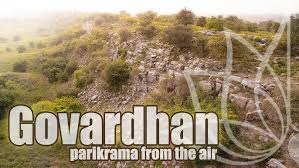
Advice from Personal Experience
Get an early start. We started early in the morning at 5:30 AM and were done by 1 PM. An early morning start ensures cooler temperatures, soft light, and a quieter environment compared to midday, when crowds gather. Have comfortable shoes or go barefoot. Many pilgrims perform the parikrama barefoot as a sign of devotion. If you prefer to have your feet covered, be sure to bring comfortable footwear since new shoes would be ill-suited for walking 21 km. Bring water and light snacks. You will come across food vendors along the way that sell chai, water, fruit, and other snacks. However, it is not advisable to depend solely on these food vendors because you should bring a litre or two of water with you right from the beginning. Have a local guide if you’ve never done it before. Though not necessary, a local guide can enhance your pilgrimage experience significantly. They will give you historical insights on each site and assist you in navigating through the confusing intersections. Lighten your load. Don’t take any extra baggage and leave your belongings in your room during your pilgrimage. All you need is a small backpack with essentials.Reaching Govardhan
It is about a distance of 22 km from Mathura. One can get there by: An auto or taxi from Mathura, which is the most convenient route, taking about 30-40 minutes to reach Local buses from Mathura or Vrindavan, which are a more economical choice, albeit less frequent A private car arranged from Agra or Delhi, many people do take both the Taj Mahal tour and then join Braj Parikrama Mathura Junction is the closest railhead since there is no train station at Govardhan.Govardhan Parikrama final conclusion :
While the Parikrama of Govardhan Hill is undoubtedly an arduous undertaking, it does give rise to feelings of spiritual elevation and enlightenment, especially because of the repetitive chanting that one hears while walking along the path. One may well have had difficult climbs in the Himalayas before; however, none of them was ever comparable to the sense of calm one feels when reaching the end of this pilgrimage and sitting near Mansi Ganga in the late afternoons. No matter how spiritual a person one might be, or how skeptical about any form of religion, the Govardhan Parikrama is one experience which should never be missed. Narmada Parikram : https://themandiryatra.com/category/yatra-guides/
Editor at The Mandir Yatra. Covers the Himalayan and northern yatras (Kedarnath, Vaishno Devi, Govardhan, Narmada Parikrama) and the southern and eastern temples (Tirupati, Kanyakumari, Srikalahasti, Draksharamam, Jagannath Puri, Kamakhya). Every guide is checked against the temple trust’s official schedule before publishing and carries a last-verified date.